
September is Alzheimer’s Awareness Month, which aims to raise awareness and challenge the stigma surrounding Alzheimer’s disease and other types of dementia.
Alzheimer’s is a brain disease that causes problems with memory, thinking, and behavior. Alzheimer’s is a progressive disease, where dementia symptoms gradually worsen over a number of years.
In its early stages, memory loss is mild, but with late-stage Alzheimer’s, individuals lose the ability to carry on a conversation and respond to their environment. On average, a person with Alzheimer’s lives four to eight years after diagnosis but can live as long as 20 years, depending on other factors.
Communication
A challenge I witnessed with dad’s Alzheimer’s was the change in communication: his and ours in trying to reach him. The Alzheimer’s Association describes four different communication strategies to help you understand approaches. I’ve linked each of the pages in case it’s helpful for you.
- Changes in communication
- Communication in the early stage
- Communication in the middle stage
- Communication in the late stage
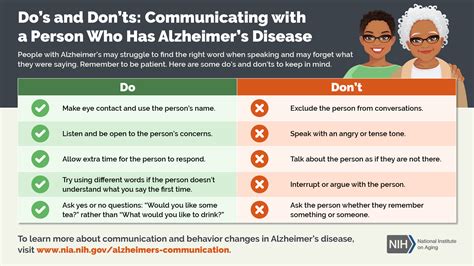
Here are some other communication tips from the NIH.
Inside the Brain
On the Alzheimer’s website, they have an “Inside the Brain” tour. If you’d like to take the tour and learn brain basics and the effect of Alzheimer’s, the link is: https://www.alz.org/alzheimers-dementia/what-is-alzheimers/brain-tour
This tour was fascinating, showing pictures of the brain and what areas control reading, hearing, thinking, and saying words. We see the three main parts of the brain and learn about the brain functions impacted by the earliest Alzheimer’s stages, mild to moderate stages, and severe Alzheimer’s.
Symptoms of Alzheimer’s
The most common early symptom of Alzheimer’s is difficulty remembering newly learned information. Just like the rest of our bodies, our brains change as we age.
Most of us eventually notice some slowed thinking and occasional problems with remembering certain things. However, serious memory loss, confusion, and other major changes in the way our minds work may be a sign that brain cells are failing.
Alzheimer’s changes typically begin in the part of the brain that affects learning. As Alzheimer’s advances through the brain, it leads to increasingly severe symptoms, including disorientation, mood and behavior changes; deepening confusion about events, time and place; unfounded suspicions about family, friends and professional caregivers; more serious memory loss and behavior changes; and difficulty speaking, swallowing and walking.
People with memory loss or other possible signs of Alzheimer’s may find it hard to recognize they have a problem. Signs of dementia may be more obvious to family members or friends.
Anyone experiencing dementia-like symptoms should see a doctor as soon as possible. If you need assistance finding a doctor with experience evaluating memory problems, your local Alzheimer’s Association can help.
Earlier diagnosis and intervention methods are improving dramatically, and treatment options and sources of support can improve quality of life. Two helpful support resources you can tap into are ALZConnected, message boards and online social networking community, and ALZNavigator™, a web tool that creates customized action plans based on answers you provide through short, online surveys.
The Alzheimer’s Association has free, online education courses if you’re interested in learning more: Understanding Alzheimer’s and Dementia and Know the 10 Signs: Early Detection Matters
The Importance of Having a POA
Having a Power of Attorney (POA) is particularly important with an Alzheimer’s diagnosis. Because it affects decision-making, a POA is essential as the condition progresses. The POA is a legal document that allows a trusted person to make decisions on behalf of the individual drafting it. **A POA only applies when we are living. **
Understand the Types of POA
- Durable Power of Attorney: Remains effective even if the individual becomes incapacitated.
- Springing Power of Attorney: Becomes effective only when a specific event occurs, such as the diagnosis of Alzheimer’s.
Choose the Right Representative
- Select a trusted individual who understands your values and wishes.
- Consider someone who is responsible and capable of handling financial and healthcare decisions (*they can be two separate people.)
Consult with Professionals
- Legal Advice: Speak with an attorney specializing in elder law or estate planning to ensure the POA meets legal requirements for your state of residence. Ask questions that pertain to your unique circumstances.
- Financial Advisor: Discuss financial implications and management strategies with a financial expert.
Distribute Copies
- Provide copies of the signed POA to those selected as your POA, healthcare providers, and financial institutions.
- Keep the original in a safe place for your files.
Review and Update as Necessary
- Review your POA’s often, to ensure it still reflects your wishes and circumstances.
- Update your POA’s if there are changes in your health, relationships, or preferences.
Communicate Your Wishes
- Discuss your healthcare and financial preferences with your POA’s and family members to ensure everyone understands your wishes.
Alzheimer’s Advancements
There are recent advancements in Alzheimer’s research that include new drug developments and diagnostic innovations. Ongoing research provides hope for more effective treatments and earlier diagnosis, potentially transforming the management of Alzheimer’s disease.
Look After You
An estimated 7.4 million Americans age 65 and older are living with Alzheimer’s in 2026, which is about 1 in 9 people in that age group. Because Alzheimer’s is in my family, I want to make sure I have my things in order and actively discuss this with my legal advisors.
I know this is difficult to think about. I also know that it is very difficult if this planning is not done.
If you have questions, please feel free to Email me. If you’d like to learn more about my work, check out my website @ The Living Planner. Let me know if there are topics of interest to you for my weekly blog. It’s always good to hear from you.
I’ve written my book for people who would like to consider planning for now and after a loss. The 2026 edition of Living Planner What to Prepare Now While You Are Living © can be purchased HERE.
Quote of the week: “Your time is limited, so don’t waste it living someone else’s life.” — Steve Jobs
Happy Fall Equinox on Wednesday! Lynn
#Can’tPredictCanPrepare #CareForPeopleCareForBusiness