

Wildfire preparedness in California becomes an important part of life for those of us who live here. We had wildfire preparedness week last week, and this is fresh in my mind. I wanted to share that fires extend well beyond California and help you prepare, too.
Wildfires don’t confine themselves to one state, one season, or one type of community. Whether you’re nestled in the hills of Southern California, the forests of Montana, the plains of Oklahoma, or the woodlands of suburban New Jersey, wildfire is increasingly a problem across the US and the world.
Preparedness is something every household can achieve. Let’s look at the facts, the impact, and the simple steps that could save your life.

Image by WOKANDAPIX from Pixabay
The Numbers Don’t Lie: Wildfires Are Everywhere
The scale of recent wildfire activity across the U.S. is sobering. In 2024 alone, nearly 65,000 wildfires burned across the country, scorching close to 9 million acres — both figures landing well above the five- and ten-year national averages, according to the National Interagency Fire Center (NIFC). The Northwest accounted for the largest share of acreage burned, while the Southern region saw the highest number of individual fires.
But 2024 was just the warm-up act.
The January 2025 Los Angeles wildfires shocked the nation. Fueled by powerful Santa Ana winds with gusts exceeding 55 mph and months of drought, the Palisades and Eaton Fires tore through some of the most densely populated neighborhoods in the country — burning over 55,000 acres, destroying more than 16,000 structures, and claiming at least 29 lives. Preliminary economic damage estimates for the LA fires alone reached between $250 billion and $275 billion, making them among the most catastrophic wildfire disasters in U.S. history.
And the fires spread far beyond California. In early 2025, Oklahoma saw over 20 wildfires burn more than 200,000 acres in March. Minnesota recorded more than 1,100 wildfires by late May 2025 — nearly an entire season’s worth of fire activity in just a few months. The Grand Canyon’s North Rim saw the historic Grand Canyon Lodge destroyed in a single fire that burned 145,500 acres. By August 2025, nearly 4 million acres had already burned across the U.S. in more than 44,000 fires — and fire season wasn’t even over.
And it’s not just the West anymore. In 2024, Massachusetts saw a 1,200% increase in wildfire frequency compared to its typical year. Fires broke out in New York, New Jersey, and Pennsylvania, sending smoke drifting over major cities and triggering air quality alerts across the Northeast.
The Hidden Cost: More Than Flames and Smoke
The devastation of a wildfire stretches far beyond the fire lines. Wildfire smoke — which can travel hundreds of miles — carries toxic particulate matter, carcinogens, and heavy metals like lead and arsenic. Research has linked wildfire smoke exposure to respiratory illness, heart disease, emergency room visits, and even adverse birth outcomes including low birth weight and preterm deliveries.
Between 2014 and 2023, wildfires caused an estimated $106 billion in global economic losses, with the United States accounting for the majority. Nine of the ten most expensive wildfire events since 1970 occurred on U.S. soil — and that was before the January 2025 California fires hit the ledger.
Communities also face long-term disruption that doesn’t make the evening news: displaced families competing for scarce rental housing, children whose schooling is interrupted, and workers whose livelihoods disappear when local businesses close. A UCLA Anderson School of Management analysis of the 2025 LA fires estimated roughly $297 million in wage losses for local workers and businesses in affected areas in 2025 alone.
The risk is growing, too. In 2022, nearly 1 in 6 Americans — approximately 80 million properties — were estimated to be at risk of wildfire. Projections suggest that by 2052, half of people at wildfire risk will live in the South.
Wildfire Preparedness: 10 Steps to Take Right Now
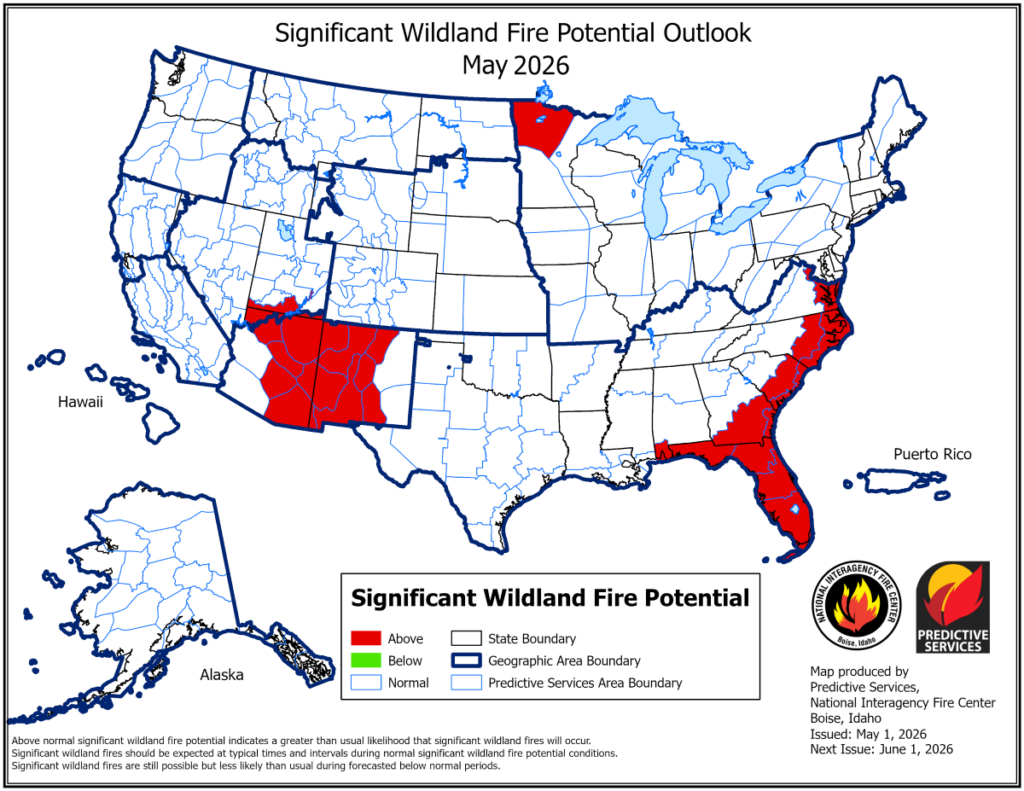
The map above represents the significant fire potential now, May 2026. States you may not think of having fire risk are, in fact, at risk.
It’s time for everyone to take wildfires seriously and get ready! You don’t have to be in California to take wildfires seriously. Here’s how to get ahead of it:
- Know your risk. Check whether your home falls in a Wildland-Urban Interface (WUI) zone using your county’s fire hazard maps or the USDA’s Forest Service resources. Even suburban and rural areas far from the West can be at risk.
- Sign up for local emergency alerts. Register with your county’s emergency notification system. Many areas use platforms like Nixle, Wireless Emergency Alerts (WEA), or local apps. Don’t wait for a TV bulletin.
- Build your Go Bag. Prepare a grab-and-go emergency kit with: N95 masks, water (one gallon per person per day for 3 days), non-perishable food, important documents (in a waterproof pouch), medications, a flashlight, a battery-powered radio, cash, phone chargers, and pet supplies if needed.
- Create a family evacuation plan. Identify two exit routes from your neighborhood and two meeting spots (one near home, one farther away). Practice the plan. Make sure everyone — including kids — knows it cold.
- Harden your home. Use fire-resistant roofing, vents, and siding when possible. Clear gutters and roofs of dry leaves. Keep wood piles away from the house. These measures can make a real difference.
- Create defensible space. Clear dry brush, grass, and dead vegetation at least 30 feet from your home. Trim trees so branches don’t touch your roof or hang over it. Check your state’s specific requirements.
- Plan for your pets and livestock. Arrange in advance where animals will go. Many evacuation shelters do not accept pets. Know which hotels, friends, or boarding facilities would take yours.
- Protect your air indoors. Keep windows and doors closed during nearby fires. Run your HVAC system on recirculate. Have N95 masks on hand — cloth masks do not filter wildfire smoke effectively.
- Document your belongings. Walk through your home with your phone and take a video inventory. Store it in the cloud or email it to yourself. This will be invaluable for insurance claims.
- Talk to your neighbors. Community preparedness saves lives. Check in on elderly or disabled neighbors who may need evacuation help and can’t do it alone.
California-Specific Resources
If you’re in California, you have access to some of the nation’s most robust wildfire preparedness infrastructure:
- CAL FIRE — calfire.ca.gov — Fire prevention tips, fire hazard severity zone maps, defensible space guides.
- Ready for Wildfire — readyforwildfire.org — Step-by-step home hardening and preparedness checklists.
- Alert SCC / Alert LA / AlertSF — County-specific emergency notification portals.
- CPUC Wildfire Safety — cpuc.ca.gov — Information on utility shutoffs (PSPS) and what to do when the power goes out.
National Resources for Every American
No matter where you live, these resources are free and built for you:
- Ready.gov (FEMA) — ready.gov/wildfires — Federal guidance on wildfire preparedness, evacuation planning, and Go Bag checklists.
- National Interagency Fire Center (NIFC) — nifc.gov — Real-time fire information, national fire maps, and preparedness levels.
- AirNow — airnow.gov — Live air quality index data by ZIP code. Essential for knowing when to stay indoors.
- Wildfire Risk to Communities (USDA) — wildfirerisk.org — Interactive maps showing wildfire risk by community across the entire U.S.
- American Red Cross — redcross.org/get-help/how-to-prepare-for-emergencies/types-of-emergencies/wildfire — Emergency app downloads, shelter locators, and disaster preparedness guides.
- CDC Wildfire Safety — emergency.cdc.gov/disasters/wildfires — Health guidance before, during, and after wildfire events.
The Bottom Line
Wildfires are no longer a regional issue. They’re an American issue. The data from 2024 and 2025 make one thing crystal clear: being caught off guard is no longer an option. Preparedness doesn’t have to be complicated — it just has to happen before the smoke rolls in.
Take one step this week. Sign up for alerts. Build your Go Bag. Have the conversation with your family. The 20 minutes you invest today could be the most important 20 minutes of your year.
If you’d like help planning, or if you’d like to talk about your planning moving forward, please click Book a Time with Lynn for a complimentary 30-minute Zoom with me. OR, send me a note via Email. Check out what I offer @ The Living Planner.
For you pre-planners, my book is a resource you might enjoy. The 2026 edition of Living Planner What to Prepare Now While You Are Living © has been printed! Check it out HERE.
Quote of the week: “Do the best you can until you know better. Then when you know better, do better” Maya Angelou
Prep now, breathe easier later! Lynn
#Can’tPredictCanPrepare #CareForPeopleCareForBusiness